
Does aloe vera help with pregnancy stretch marks?
Answer
Topical aloe vera is pregnancy-safe and hydrating, but no topical product reliably prevents stretch marks. Genetics and skin elasticity drive most of the outcome. Daily moisturizing helps comfort more than prevention.
The honest truth about stretch marks
Stretch marks (striae gravidarum) develop in 50–90% of pregnancies, most commonly on the abdomen, breasts, thighs, and hips. They occur when the dermis (middle skin layer) stretches faster than its collagen and elastin can adapt, causing the tissue to tear at a microscopic level and heal as visible bands1.
The factors that actually predict stretch mark formation:
- Genetics — family history is the single strongest predictor
- Age at first pregnancy — younger skin has less mature collagen, more vulnerable to tearing
- Rate of pregnancy weight gain — faster gain means more stretching pressure
- Skin type — some skin types are more prone
- Hormonal factors — cortisol levels during pregnancy
Topical products account for very little of the variance. No topical product has been shown in well-controlled trials to reliably prevent stretch marks — including the expensive prescription and “specialty pregnancy” creams2.
What aloe specifically does
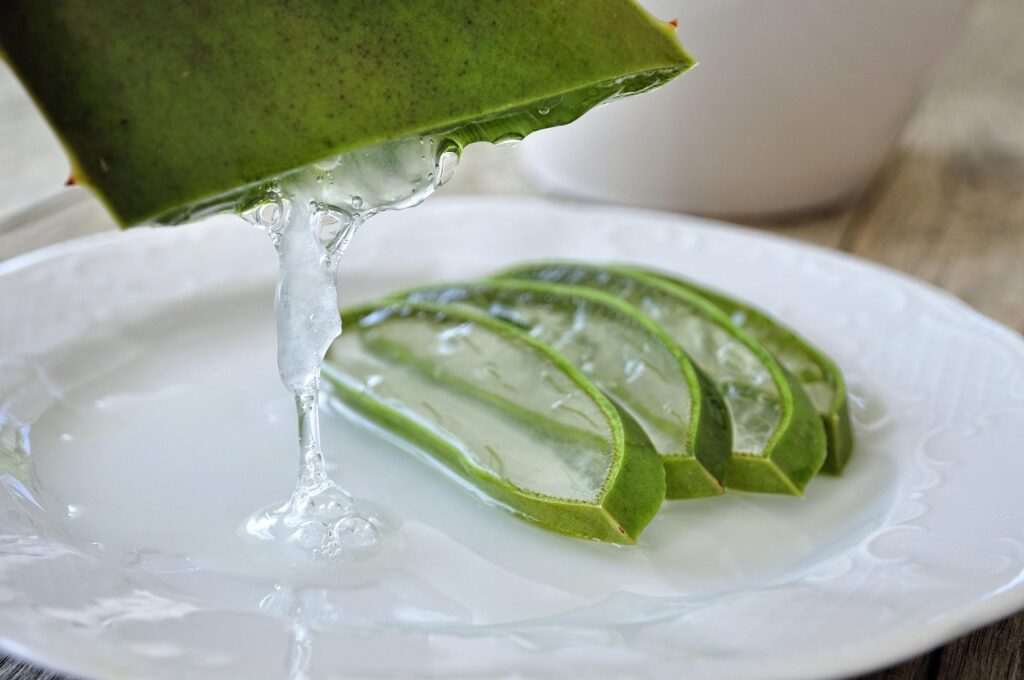
Topical [aloe vera](/ingredients/aloe-vera/) provides:
- Hydration — the gel is mostly water and humectant polysaccharides
- Anti-inflammatory effects — soothing for the pulling and itching sensations that accompany stretching skin
- Mild wound-healing support — documented in topical studies for minor wounds and burns
- Cooling sensation — comfort during third-trimester itch and tightness
What aloe doesn’t do: meaningfully prevent stretch marks from forming, dramatically fade existing ones, or replace the structural integrity that genetics determined. Treat aloe as comfort care, not stretch-mark insurance.
What evidence suggests “might help slightly”
The small body of evidence supports modest benefit from:
- Daily moisturization with rich emollients (cocoa butter, shea butter, aloe gel, ceramide creams). Hydrated skin is more flexible3
- Hyaluronic acid + Centella asiatica combinations (used in some “Trofolastin”-type prescription creams in Europe) — modest evidence base
- Onset early — starting in second trimester rather than waiting for marks to appear
- Massage — the daily massaging may matter as much as the product
None of these will prevent stretch marks in a genetically-prone patient. But for someone in the middle, they may reduce severity by a small amount.
What to do about existing stretch marks
For active red/purple stretch marks (recent, still inflamed) during pregnancy: hydration and time. They naturally fade to silvery-white over 12–24 months postpartum.
Postpartum treatments with stronger evidence:
- Topical [tretinoin](/ingredients/tretinoin/) — for red stretch marks; postpartum after breastfeeding only
- Fractional laser treatments — modest improvement in mature stretch marks
- Microneedling — some collagen-remodeling benefit
- Radiofrequency treatments — tightening for laxity that accompanies stretch marks
A pragmatic pregnancy stretch-mark routine
- Apply aloe gel, cocoa butter, or shea butter twice daily across belly, breasts, hips, and thighs
- Massage in gently in circular motions for 1–2 minutes per area
- Drink water consistently (skin hydration starts internally)
- Don’t expect prevention — treat the routine as self-care, anti-itch, and comfort
- Be patient postpartum — most stretch marks fade significantly with time alone
Related ingredients
Aloe Vera
Topical aloe vera is pregnancy-safe with a long traditional and modern usage record. Soothing for sunburn, pregnancy itch, dry skin. NOTE: oral…
Hyaluronic Acid
Good news, mama! Hyaluronic Acid (HA) is a skincare superstar that's generally safe for use during pregnancy. Since it's naturally produced by…
Ceramides
Ceramides are fully pregnancy-safe. They are lipid molecules identical to those naturally in your skin's barrier — restoring rather than altering native…
Sources
- Korgavkar K, Wang F. (2015). Stretch marks during pregnancy: a review of topical prevention. British Journal of Dermatology. View source →
- Brennan M, Young G, Devane D. (2012). Topical preparations for preventing stretch marks in pregnancy. Cochrane Database of Systematic Reviews. View source →
- Surjushe A, Vasani R, Saple DG. (2008). Aloe vera: a short review. Indian Journal of Dermatology. View source →